
Phu Chau Floating Temple: Discover a 300-Year-Old Hidden Gem in Saigon
When people think about exploring the rivers of Vietnam, they often imagine the Mekong Delta, floating markets, coconut canals, and peaceful countryside. But did you know that you can find a fascinating floating temple right here in Ho Chi Minh City? Hidden on a small islet in the Vàm Thuật River, Phù Châu Miếu, also known as Miếu Nổi or the Floating Temple, is one of the most unusual cultural and spiritual places I have discovered in Saigon.
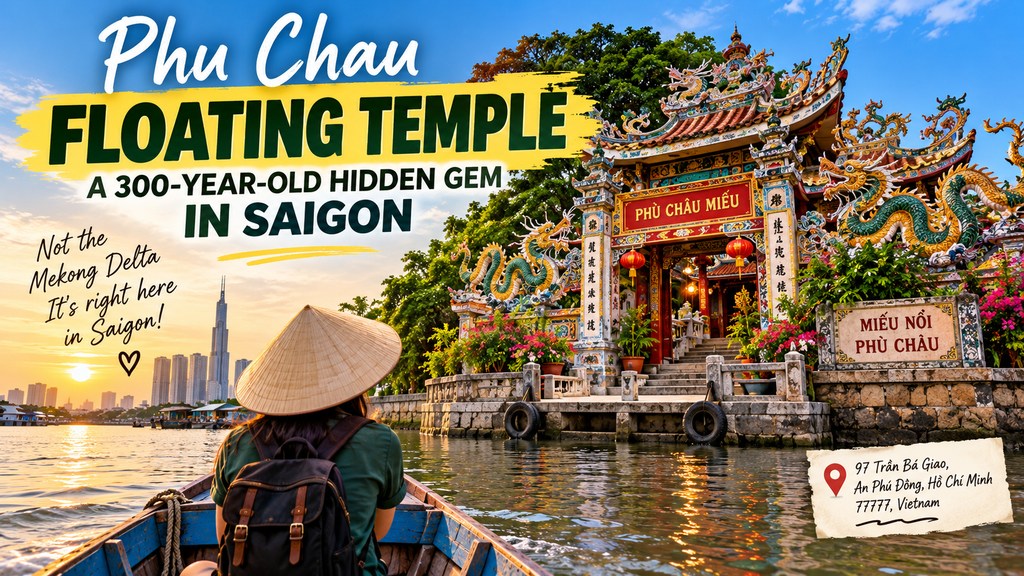
Located in the Gò Vấp area of Ho Chi Minh City, the temple sits on a small island surrounded by water. From the busy streets nearby, it feels almost impossible to imagine that such a peaceful place is hiding just a short distance away. The temple has been associated with the area for more than 300 years and is considered one of the city’s distinctive religious and architectural sites.
A Hidden Temple in the Middle of the River
One of the most interesting things about Phu Chau Temple is that you cannot simply walk there. To reach the temple, visitors have to take a short boat ride across the river. The journey only takes a few minutes, but it creates a surprisingly dramatic change in atmosphere. One moment you are surrounded by the noise, traffic, and activity of Saigon, and a few minutes later you arrive at a quiet little island surrounded by water.
This unique location is one of the reasons locals call it Miếu Nổi, which literally refers to a shrine that appears to “float.” The temple occupies a small river islet of roughly 2,000–2,500 square meters on the Vàm Thuật River.
The boat ride itself is part of the experience. As you move away from the riverbank, the sound of the city gradually fades behind you. Looking back from the boat, you can see the contrast between everyday Saigon life and this colorful spiritual site sitting quietly in the middle of the water.
A History Dating Back More Than 300 Years
The exact date when Phù Châu Miếu was first built is not completely clear. Historical and local sources generally place its origins more than three centuries ago, with some accounts connecting its early history to the 18th century or the period of the Nguyễn dynasty. Because the temple has been rebuilt and restored several times, separating historical records from local legends can be difficult.
There are several stories about how the shrine began. One popular local legend tells of a fisherman who discovered the body of a woman while fishing in the river. He buried her on the small island and established a simple shrine there. Another version of the story says that fishermen discovered a sacred statue in the river and built a shrine on the island to honor it. Over time, the small shrine became an important place of worship for people living and working along the waterways.
These stories are part of the temple’s local folklore, rather than a single definitively documented origin story, but they help explain why the shrine became closely connected with the river, fishermen, and people’s wishes for safety and good fortune.
A Temple Filled With Dragons and Colorful Details
The first thing you may notice when arriving at Phu Chau Temple is the incredible amount of decoration. Dragons seem to be everywhere—on walls, columns, rooftops, gates, and other architectural details. The temple is known for its elaborate ceramic and mosaic decorations, creating an appearance that is very different from many other religious buildings you might see around Ho Chi Minh City.
The architecture also reflects an interesting blend of Vietnamese and Chinese cultural influences. Bright colors, intricate carvings, ceramic pieces, statues, and traditional motifs cover much of the temple complex, making almost every corner worth looking at.
For me, this is one of the most fascinating things about visiting the temple. It is not simply a place to take a boat to and see from the outside. Once you walk through the gates, there are so many small details that you can easily spend time exploring the architecture and trying to understand the stories represented through the decorations.
A Peaceful Spiritual Escape From Saigon
What makes Phu Chau Temple particularly special is the contrast between its surroundings and the rest of Ho Chi Minh City. Saigon is famous for its traffic, motorcycles, skyscrapers, cafés, markets, and constant movement. Yet in the middle of the river, everything suddenly feels slower.
You can hear the water, feel the breeze, and see boats moving along the river while the colorful temple stands quietly on the island. Many visitors come here not only to see the architecture but also to pray and find a moment of peace. The Vietnamese government’s Committee for Religious Affairs has described the site as a sacred temple whose architecture combines Vietnamese and Chinese cultural elements.
For travelers who want to see a different side of Saigon beyond the famous attractions in District 1, this is exactly the kind of place I would recommend exploring.
Where Is Phu Chau Floating Temple?
Phu Chau Floating Temple is located at 97 Trần Bá Giao, Ho Chi Minh City, in the area formerly known as Gò Vấp District. The current location listing identifies the temple at this address, while recent travel information uses the newer ward-based administrative address.
The temple is situated along the Vàm Thuật River, with the river separating it from the surrounding urban neighborhoods. Because of its unusual location, you will need to take the local boat to cross to the temple.
The boat fare has been reported at different prices over the years, so I would recommend checking the current price when you arrive rather than relying on an old fixed price. Historical sources have reported fares around 10,000 VND per trip, while more recent travel information gives different figures.
Is Phu Chau Temple Worth Visiting?
If you are looking for the typical first-time tourist attractions in Ho Chi Minh City, Phu Chau Temple may not be at the top of your list. But if you want to discover hidden Saigon, local culture, history, architecture, and places that most visitors don’t know about, this is a very interesting stop.
What I love about places like this is that they remind us that Saigon is much more than busy streets and modern buildings. There are old stories, traditional beliefs, local communities, and unexpected cultural treasures hidden between the neighborhoods.
And perhaps the most surprising part is that you don’t need to travel to the Mekong Delta to experience this feeling. You can find it right here in Saigon.
Discover the Hidden Side of Saigon With Saigon Taste Tours
After living and working in Saigon for years, I’ve always believed that some of the city’s most interesting experiences are not necessarily the most famous ones. Sometimes, you just need to turn down a small street, follow a local recommendation, or cross a river to discover another side of the city.
At Saigon Taste Tours, we love creating experiences that go beyond the typical tourist attractions. From local food and hidden alleys to historical sites, river experiences, Cu Chi Tunnels, the Mekong Delta, and unique cultural destinations like Phu Chau Floating Temple, our goal is to help travelers experience Saigon like a local.
Discover the city beyond the tourist spots with Saigon Taste Tours. Come explore the real Saigon with us – where you don’t just see the city, you taste it.
For custom itineraries and group bookings, pricing depends on group size. Contact Ben via WhatsApp: +84 383 624 632. If you have any questions, please don’t hesitate to ask.We are looking forward to showing you around our lovely country!
Book your experience today and discover Vietnam like a local!

Saigon Taste Tours team
Welcome to SAIGON TASTE Tours! We’re a team of passionate local guides dedicated to sharing the real Saigon and Vietnam through food, culture, and hidden gems. From bustling street food stalls and historic landmarks to outdoor adventures and peaceful nature escapes, our tours are designed to be authentic and unforgettable. Every experience is private and tailored to you, guided by knowledgeable locals who go above and beyond to make you feel like you’re exploring with a friend. With us, you won’t just visit Vietnam — you’ll truly experience it. We can’t wait to welcome you! Best regards, Ben and the SAIGON TASTE Tours
saigontastetours@gmail.com Click to Connect with Us
Leave a Reply