Vietnam Mid-Autumn Festival: History, Legends & Traditions
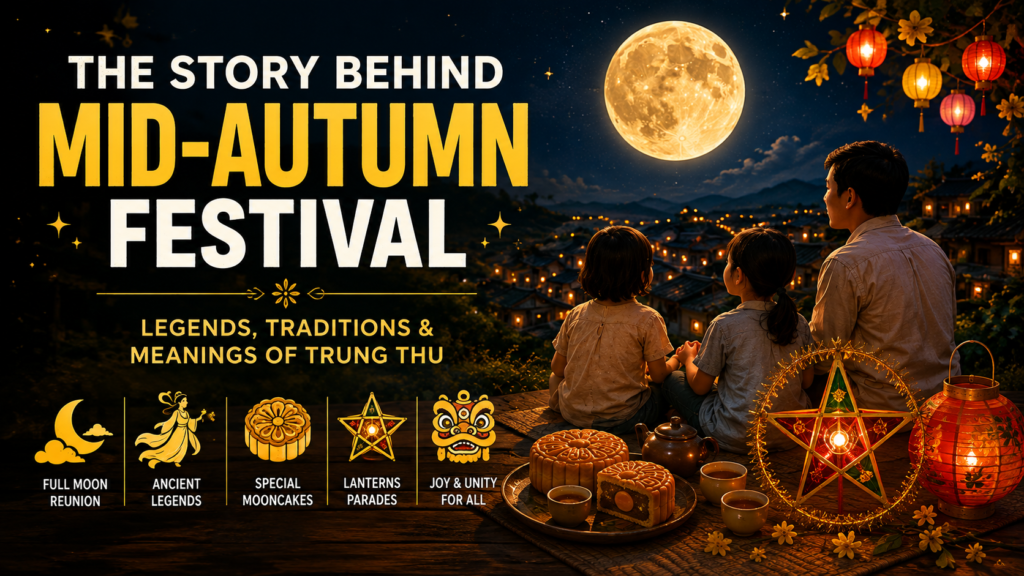
The Story Behind Vietnam’s Mid-Autumn Festival
Imagine walking through a Vietnamese neighborhood on a warm evening in autumn.
Colorful lanterns are glowing along the streets. Children carry star-shaped lanterns while singing and laughing. The sound of drums grows louder as a lion dance approaches. Families sit together, sharing mooncakes and tea while looking up at the full moon.
This is Tết Trung Thu, Vietnam’s Mid-Autumn Festival.
For Vietnamese people, Trung Thu is much more than a festival featuring mooncakes and lanterns. It is a celebration connected to the full moon, traditional culture, family reunion, childhood memories, and seasonal harvests.
But where did this festival come from? Why is it celebrated on the 15th day of the eighth lunar month? And why do Vietnamese children carry lanterns and watch lion dances?
Let’s take a journey into the stories and traditions behind one of Vietnam’s most beloved festivals.
Why Is It Called the Mid-Autumn Festival?
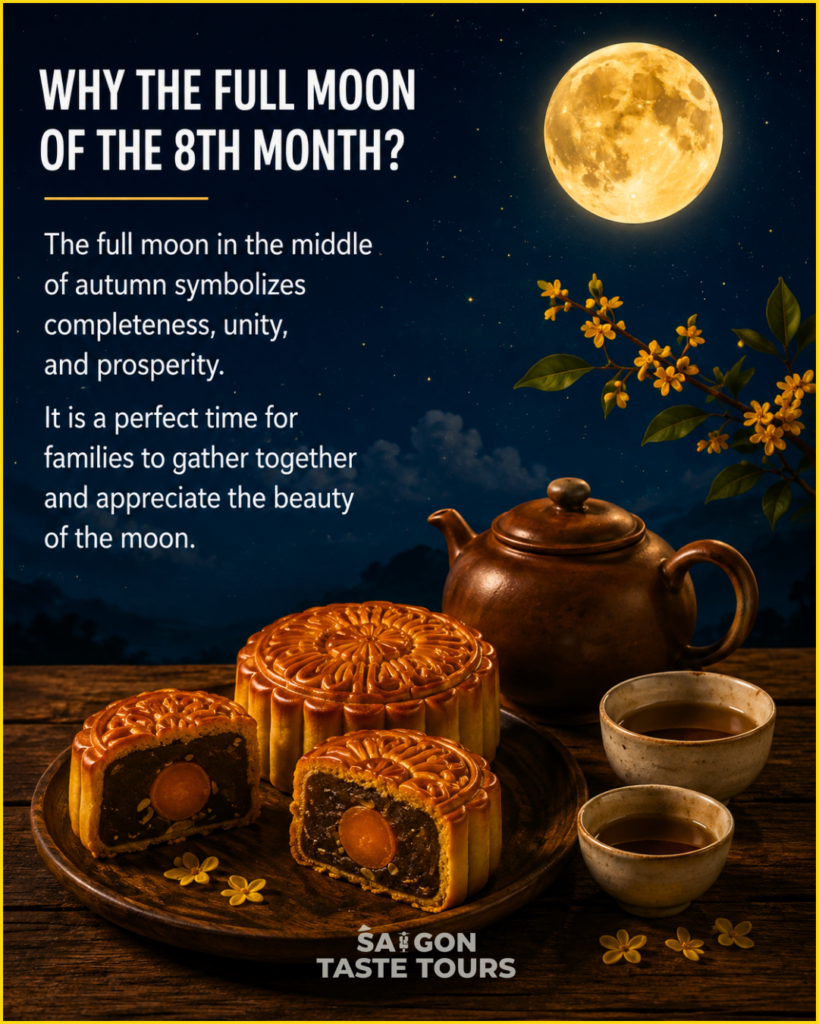
The Vietnamese name Tết Trung Thu literally means “Mid-Autumn Festival.”
The word Trung means “middle,” while Thu means “autumn.” In the traditional lunar calendar, the seventh, eighth, and ninth lunar months were associated with autumn, making the eighth lunar month the middle month of the season.
The festival takes place on the 15th day of the eighth lunar month, the full-moon night.
But there is an interesting question:
If there is a full moon every month, why is the full moon of the eighth lunar month so special?
The Full Moon and the Harvest
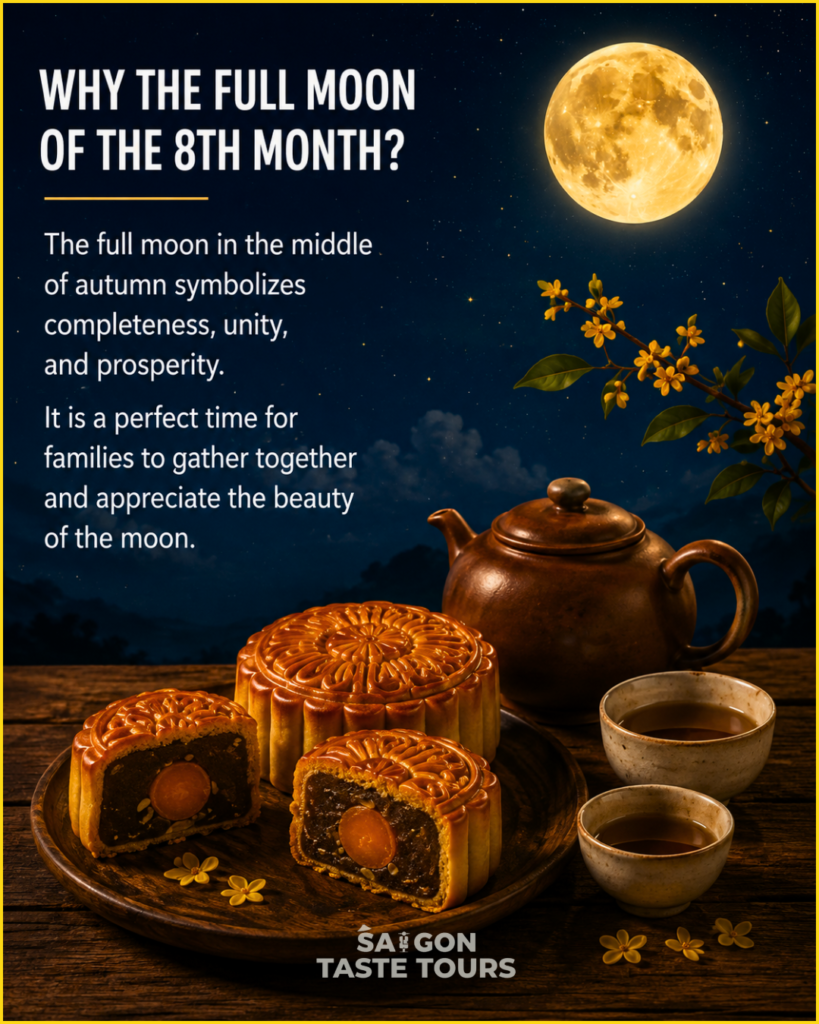
The answer is not simply that the Moon is brighter or more perfectly round in August. There is a full moon every lunar month.
Instead, the importance of this particular full moon developed from its place in the traditional calendar and agricultural cycle.
In many traditional agricultural societies in East Asia, autumn was an important season associated with harvests and abundance. The eighth lunar month often fell around a period when various crops and fruits were being harvested or reaching maturity, although the exact timing varied from region to region.
The full moon therefore became a natural occasion for people to celebrate, give thanks, and wish for prosperity and abundance.
There was also another beautiful connection.
The Moon appears perfectly round and complete on the night of the full moon. In traditional East Asian culture, this roundness came to symbolize completeness, harmony, and reunion.
This created a powerful combination:
- The harvest represented abundance.
- The full moon represented completeness.
- Family gathering represented reunion.
Over time, these ideas became deeply connected to the meaning of the Mid-Autumn Festival.
The Legends of the Mid-Autumn Festival
Like many traditional festivals, Trung Thu is surrounded by fascinating stories and legends.
Some of the most famous Mid-Autumn legends originated in Chinese culture, while Vietnam also has its own beloved stories that have been passed down from generation to generation.
The Legend of Chang’e and Hou Yi
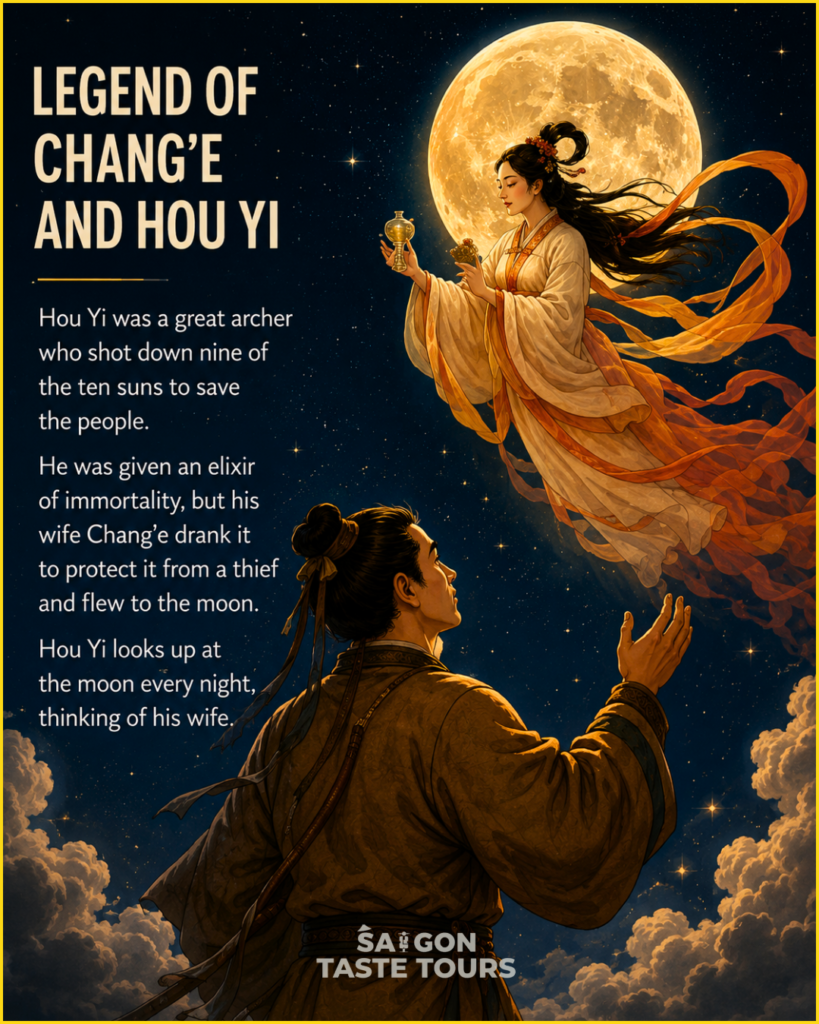
One of the most famous stories associated with the Mid-Autumn Festival is the legend of Chang’e and Hou Yi.
According to Chinese mythology, Hou Yi was a powerful archer who saved the world when ten suns appeared in the sky and scorched the Earth. He shot down nine of them, leaving only one sun to provide light and warmth.
As a reward, Hou Yi received an elixir of immortality.
However, he did not want to become immortal without his beloved wife, Chang’e, so he chose not to take it.
According to one version of the legend, someone later attempted to steal the elixir while Hou Yi was away. To prevent it from falling into the wrong hands, Chang’e drank it herself.
She became immortal and flew to the Moon.
When Hou Yi realized what had happened, he looked up at the Moon and mourned the loss of his beloved wife.
The story became closely associated with the full moon and the Mid-Autumn Festival.
Today, Chang’e is often depicted as a beautiful woman living on the Moon.
The Vietnamese Legend of Chú Cuội
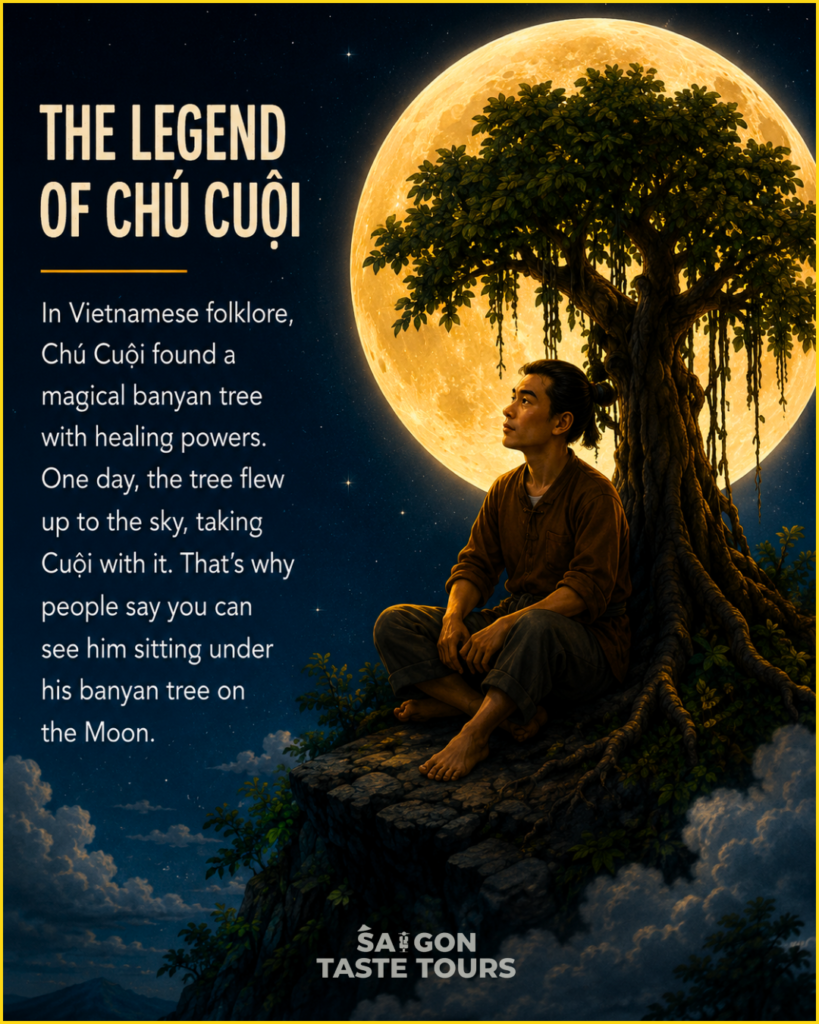
Vietnam has its own famous Moon legend: the story of Chú Cuội.
According to Vietnamese folklore, Cuội discovered a magical banyan tree with extraordinary healing powers.
The tree could be used to cure illness, but it had to be cared for carefully.
One day, the tree suddenly began to rise into the sky.
Cuội tried desperately to hold onto it, but he was eventually carried away with the tree all the way to the Moon.
And that is why Vietnamese children have traditionally been told that if they look carefully at the full Moon, they may be able to see Chú Cuội sitting underneath his banyan tree.
The image of Cuội and his banyan tree became an important part of Vietnamese childhood and is still familiar to many Vietnamese people today.
Why Is Trung Thu Called a Festival for Children?
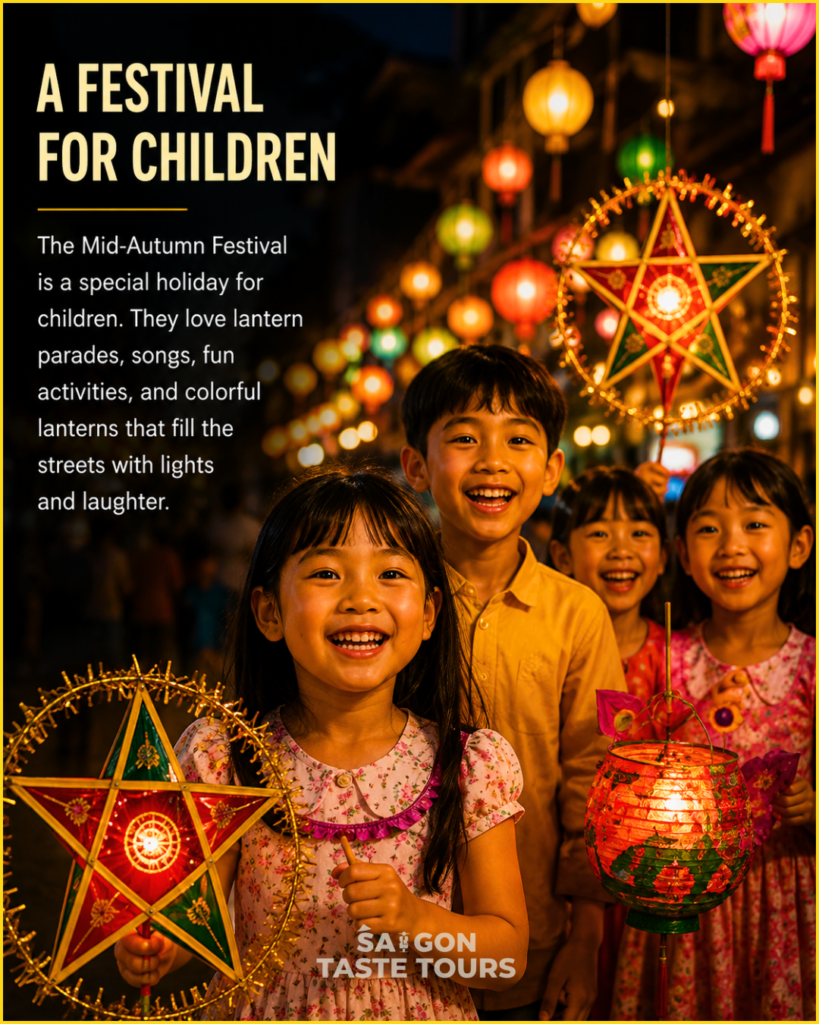
Although the Mid-Autumn Festival has deeper cultural connections to the Moon, seasonal cycles, and family reunion, in modern Vietnam it is especially associated with children.
For Vietnamese children, Trung Thu is one of the most exciting nights of the year.
They receive colorful lanterns, gather with friends, walk through their neighborhoods, sing traditional songs, watch performances, and follow lion dance groups through the streets.
It is a night filled with light, music, laughter, and excitement.
One of the most iconic Vietnamese lanterns is the star lantern, known as đèn ông sao.
Traditionally made from bamboo and colorful paper, the five-pointed star lantern has become one of the most recognizable symbols of Vietnamese childhood.
For generations of Vietnamese children, carrying a glowing lantern through the neighborhood on Trung Thu night has been a treasured childhood memory.
The Tradition of Lantern Parades
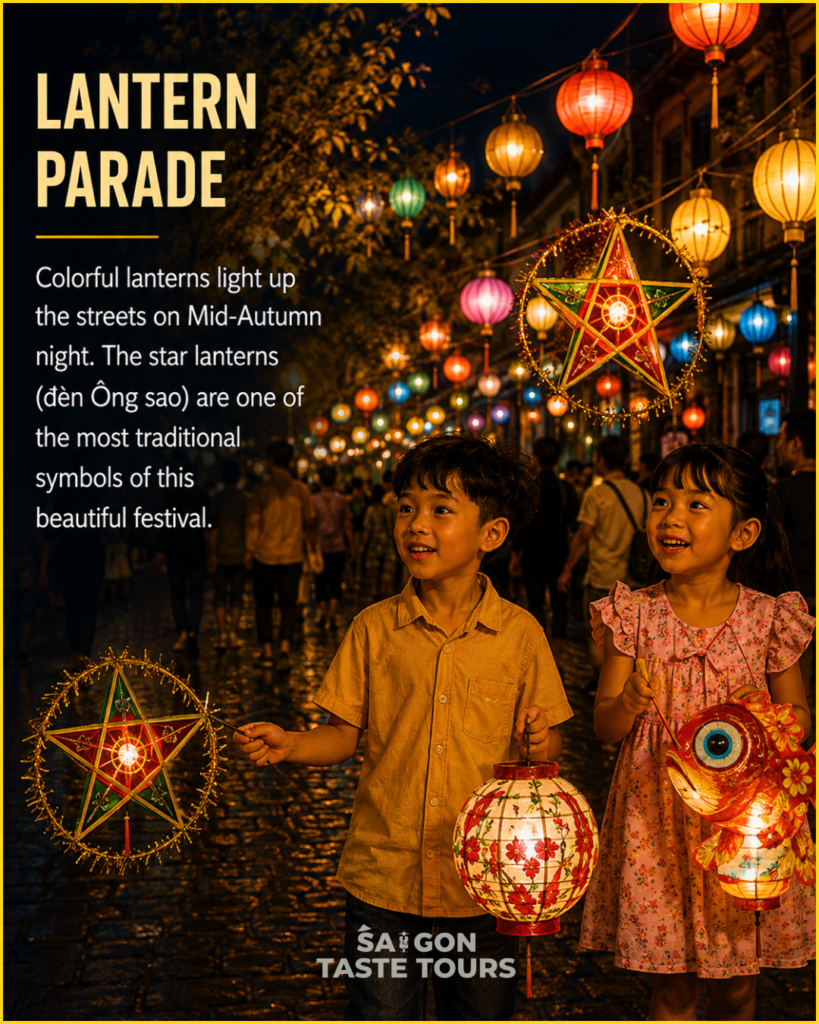
One of the most recognizable sights during Vietnam’s Mid-Autumn Festival is the lantern parade.
As night falls, children carry lanterns through the streets, often accompanied by their parents, friends, and neighbors.
The lanterns come in many different shapes and colors, although the traditional star lantern remains particularly popular.
In some communities, children walk together in groups while singing traditional Mid-Autumn songs.
The streets can become filled with hundreds of colorful lights, creating a magical atmosphere that is especially beautiful after dark.
Today, lantern parades can be seen in many parts of Vietnam, from small neighborhoods to large organized celebrations.
Why Do Vietnamese People Have Lion Dances During Trung Thu?
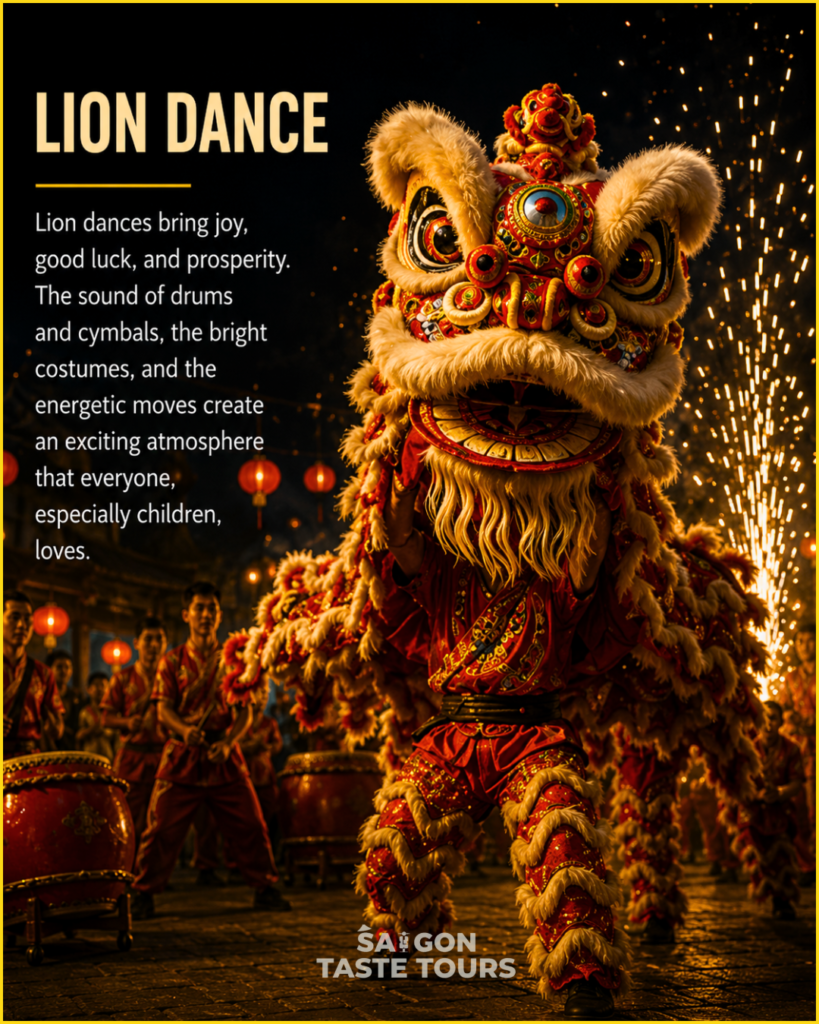
When the drums begin to beat, you know something exciting is about to happen.
The lion dance is coming.
Vietnamese lion dance is called múa lân.
Although it is commonly translated into English as “lion dance,” the creature represented in Vietnamese traditions is a mythical lion-like creature, rather than a realistic lion.
In Vietnamese culture, the lân is traditionally associated with good fortune, prosperity, happiness, and protection from negative influences.
During a performance, dancers move inside an elaborate lion costume, creating the impression that the creature is alive.
The performance is accompanied by powerful drums, cymbals, and other instruments. The lion may jump, bow, dance, interact with spectators, and perform impressive movements.
For children, the arrival of the lion dance is often one of the most exciting moments of Trung Thu.
The combination of drums, colorful costumes, lanterns, and dancing transforms an ordinary neighborhood into a lively celebration.
Mooncakes: The Taste of Trung Thu
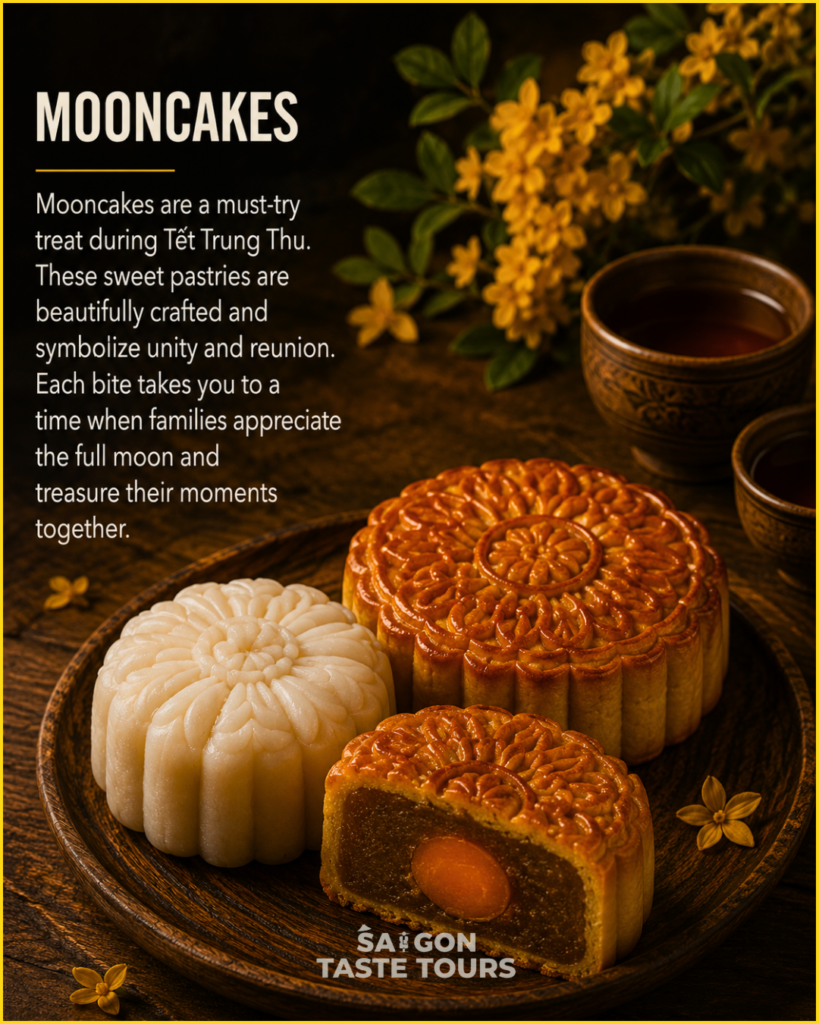
Of course, no Mid-Autumn Festival in Vietnam would be complete without mooncakes.
Mooncakes are one of the most recognizable foods associated with Trung Thu.
Two traditional Vietnamese varieties are:
Bánh Nướng – Baked Mooncakes
Bánh nướng are baked mooncakes with a golden-brown crust.
They can contain a wide variety of fillings, including lotus seed paste, mung bean paste, mixed nuts, and salted egg yolks.
Bánh Dẻo – Soft Mooncakes
Bánh dẻo have a soft, chewy white exterior traditionally made with glutinous rice flour.
They are often filled with sweet bean or lotus paste and may also contain salted egg yolks.
Mooncakes are traditionally round, reflecting the shape of the full Moon.
Their round shape also represents ideas of completeness, unity, and family reunion.
Mooncakes, Tea, and Moon Gazing
On the evening of Trung Thu, families may gather together to enjoy mooncakes, fruit, tea, and other treats while admiring the full Moon.
This simple tradition captures one of the most beautiful aspects of the festival.
There is no need for an elaborate celebration.
Sometimes it is simply:
- A mooncake.
- A cup of tea.
- A bright full moon.
- And the people you love sitting beside you.
The festival creates an opportunity for families to slow down, spend time together, share stories, and appreciate one another.
The Meaning of the Mid-Autumn Festival Today
The meaning of Trung Thu has evolved over centuries, but many of its traditional themes remain.
It is a celebration of family, togetherness, childhood, nature, seasonal abundance, and cultural traditions.
For children, it is a night of lanterns, mooncakes, songs, and lion dances.
For parents, it can be a chance to create special memories with their children.
For grandparents, it can be a reminder of their own childhood.
And for families separated by distance, it is traditionally a time to come together.
Perhaps this is why the image of the full Moon is so appropriate.
A full Moon is round, complete, and shared by everyone beneath the same sky.
Experiencing Tết Trung Thu in Vietnam
If you happen to be in Vietnam during the Mid-Autumn Festival, take some time to experience it beyond the mooncakes sold in supermarkets.
Walk through a local neighborhood after dark.
Look for children carrying lanterns.
Listen for the sound of lion dance drums.
Visit a traditional lantern street.
Try a freshly made mooncake with a cup of Vietnamese tea.
And, if the sky is clear, take a moment to look up at the full Moon.
You may even find yourself thinking about the old stories of Chang’e, Hou Yi, and Chú Cuội that generations of children have heard beneath that same Moon.
The Mid-Autumn Festival is not simply a celebration of the Moon.
It is a celebration of tradition, family, childhood, harvest, legends, and togetherness.
And perhaps that is the real magic of Tết Trung Thu.
Long after the lanterns have gone out and the last mooncake has been eaten, the memories remain.
Have You Ever Celebrated Trung Thu in Vietnam?
Have you experienced Vietnam’s Mid-Autumn Festival?
What would you enjoy most — carrying a lantern, watching a lion dance, eating mooncakes, or sitting under the full Moon with your family?
Share your favorite Trung Thu memory in the comments.
Discover the city beyond the tourist spots with Saigon Taste Tours. Come explore the real Saigon with us – where you don’t just see the city, you taste it.
For custom itineraries and group bookings, pricing depends on group size. Contact Ben via WhatsApp: +84 383 624 632. If you have any questions, please don’t hesitate to ask.We are looking forward to showing you around our lovely country!
Book your experience today and discover Vietnam like a local!

Saigon Taste Tours team
Welcome to SAIGON TASTE Tours! We’re a team of passionate local guides dedicated to sharing the real Saigon and Vietnam through food, culture, and hidden gems. From bustling street food stalls and historic landmarks to outdoor adventures and peaceful nature escapes, our tours are designed to be authentic and unforgettable. Every experience is private and tailored to you, guided by knowledgeable locals who go above and beyond to make you feel like you’re exploring with a friend. With us, you won’t just visit Vietnam — you’ll truly experience it. We can’t wait to welcome you! Best regards, Ben and the SAIGON TASTE Tours
saigontastetours@gmail.com Click to Connect with Us
Leave a Reply